How do we remove the walking hazzards caused by large trees in our narrow local streets? Accessible Streets aims to improve pedestrian accessibility with wider, cooler footpaths.
Overview
This program guides Council’s asset renewal program with a co-ordinated design approach for very narrow and obstructed footpaths due to the pressure of large trees in local streets. The aim is to increase street tree canopy cover and improve pedestrian accessibility and amenity. Strategic links to key destinations and public transport will be prioritised for the delivery of this initiative.
Tree leaning over footpath
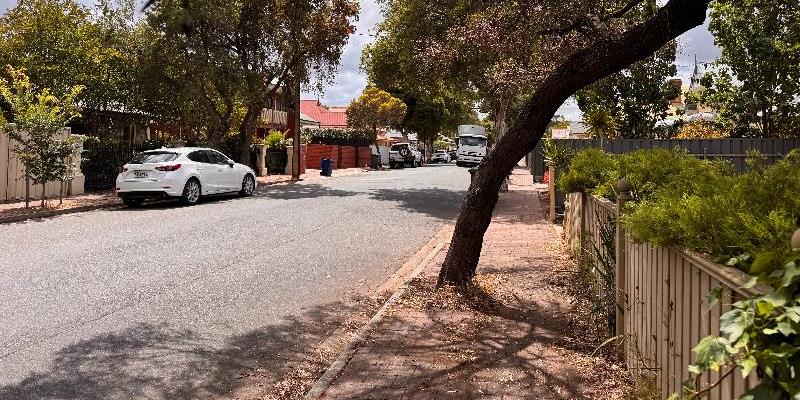
Tree obstructing narrow footpath

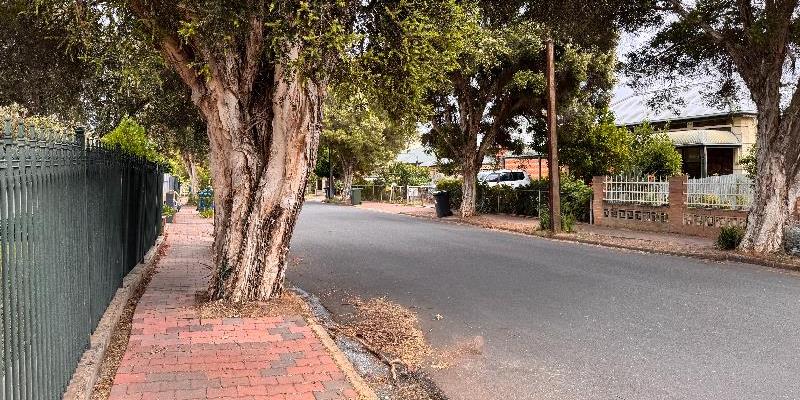
Large tree obstructing footpath
Design approach
Each Accessible Street will be designed with:
• Changes to create slower, safer, cooler, greener and friendlier streets.
• A focus on asset renewal and low level civil design solutions (rather than full road reconstruction).
• Kerb alignments and road width may be altered to increase footpath and verge width.
• An accessible and clear footpath on one side of a street (at least), when space in the street is limited.
• New trees planted in the roadway, rather than the footpath, using an appropriate tree species suitable for under overhead power lines.
• A mix of street tree species for greater biodiversity and wildlife habitat.
• Increased tree canopy cover for comfortable, cool and green streets.
• Very large and aged trees only removed as a last resort based on tree condition audit results.
• Minimal loss of street car parking, unless there is no other option.
• Tree pits designed to naturally water trees by directing stormwater runoff.
Asymmetrical street profile solutions

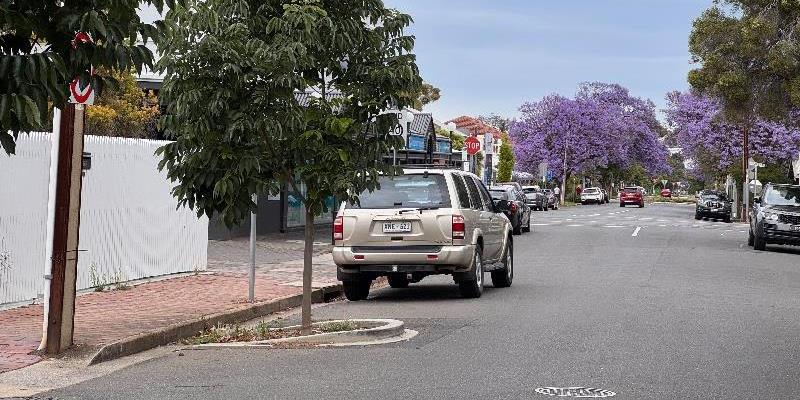
New trees planted on road protuberances
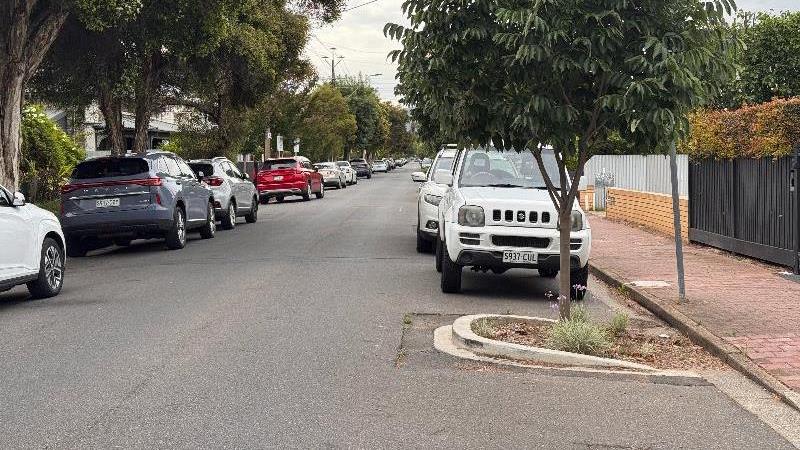
New trees sharing space with parked cars
Why are we doing this?
The current conditions and issues found for the selected streets are:
- Very large trees obstructing footpaths and pedestrian paths of travel.
- Trip hazards from pavers lifted by tree roots.
- Aging tree population in Unley, which will need staged replacement/succession planting.
- Limited opportunities due to narrow streets for more tree canopy cover and pedestrian space.
- Overhead power lines and underground services in footpaths limit where new trees can be planted.
- Impact to parking may be reduced if a new tree is planted in the roadway directly adjacent to a driveway, which needs to be balanced with not impacting access.
- A narrow street profile in many local streets limits possible design solutions due to lack of space.
- Need for greater diversity in the tree species throughout Unley to mitigate the risk from pest attacks, disease, and climate change.
- Need to future-proof street trees (and tree species) for a drier and hotter climate and drought.
The current opportunities for the selected streets are:
- To encourage walking and maintain greener neighbourhoods for mental and physical health, community connections and as a sustainable form of transport.
- A shaded footpath network with protection from the sun and extreme heat while walking.
- To fill gaps in biodiversity corridors and to provide wildlife habitat in inner Adelaide.
- Urban heat island effects can be reduced with shady, green streets to help cool the city.
- To align the annual footpath and kerbing renewal and street tree planting programs with the Accessible Streets implementation.
Which Streets?
City of Unley has over 513 local roads and lanes in total and the Accessible Streets program will consider 64 local streets that have a known footpath restriction of less than 0.9m. This affects approximately 10% of the local street network. We will do this incrementally by assessing and targeting a couple of streets each year, as a part of the annual asset and road renewal program.
How to create an 'Accessible Street'
Design solutions
Each Accessible Street design may vary slightly, as all streets are slightly different, but all will include:
- An asymmetrical street profile, which is unlike a traditional / typical street, with a consistent avenue of one type of tree and matching footpaths.
- A shift from a car-centric focus to being pedestrian friendly by enabling more space for footpaths in narrow streets with adequate space for vehicle movements. This may mean moving the kerb alignment 200-300mm, while maintaining space for car parking and the path of travel for cars and rubbish trucks.
- New trees will likely to be in the roadway to keep the footpaths clear and to avoid services.
- An Australian Standard compliant footpath with a clear path of travel, on (at least) one side of the street (1.2m - 1.5m).
- The staged removal of some trees obstructing the footpath (strictly based on age, condition, life span left).
- A robust and diverse street tree character with a mix of species selected on suitability to climate changes and available space.
- A 30% minimum tree canopy cover along the street by staging the tree removal and replacement (succession planting). The staged planting may occur over several years to achieve the desired outcome.
- Some car parking may have to be removed, to accommodate any tree planting in the roadway, which will be minimised as much as possible by planting between and at the ends of car park bays.
- Water sensitive urban design solutions to passively water trees with stormwater runoff, such as breaks in kerbs and Treenet inlets.
- Permeable surfaces around trees to allow more water to soak into the ground, such as gravel mulch or permeable pavers.
- Improved pedestrian crossings, pram ramps and links that are all DDA compliant.
- New shade trees in private front yards is also encouraged to help to shade the footpaths and streets.
Timeframes
Council will aim to deliver two streets per year. Streets will be prioritised based on the asset renewal program, condition of the street (road, kerb and footpath), simplicity of design solution and strategic importance. Local residents will be notified at the design stage and again prior to the start of construction in their street. The succession tree planting may happen over several years as the tree removal and replacement is staged to ensure at least 30% tree canopy cover is retained as a minimum throughout the street regeneration.
Tree Targets
The Unley Tree Strategy will be superseded by the Urban Forest Action Plan 2026-2030 which will outline future tree canopy targets for the City. Council also has annual tree planting program targets for tree planting. Generally, however, the aim is to maintain a consistent 30% cover or more in local streets. Achieving this will depend not only on the numbers of trees, but also the mature size and spread of the tree species selected. Where a replacement tree is not possible, then the amount of shade should not be reduced (for example, fewer but larger trees).
Suitable New Tree Species
Council will design to plant a variety of species. Two species Jacaranda mimosifolia (Jacaranda) and Lophostemon confertus (Queensland Box) represent over 42% of the street tree population, so Unley’s tree population needs to diversify. Accessible streets will typically include small to medium trees planted within footpaths and beneath overhead power lines, with larger trees located within the roadway where adequate clearance from overhead power lines is available. Each street may include some of the following trees;
Large Trees
These would be planted in a road protuberance;
- Agonis flexuosa (WA Willow Myrtle)
- Angophora costata (Smooth-barked Apple)
- Corymbia maculata (Spotted Gum)
- Eucalyptus torquata (Coral Gum)
- Brachychiton populneus ‘Discolour’ (Griffith Pink)
- Fraxinus angustifolia ‘Raywood’ (Claret Ash)
Small-Medium Trees
- Corymbia eximia nana (Dwarf Yellow Bloodwood)*
- Eucalyptus leucoxylon ‘Euky Dwarf’ (Dwarf SA Blue Gum)*
- Eucalyptus forrestiana (Fuchsia Gum)*
- Geijera parviflora (Wilga)*
- Melia azedarach (White Cedar)*
- Tristaniopsis laurina (Kanooka)*
*Tree species under power lines will need to conform to the Office of the Technical Regulator (OTR).
How Is A Decision Made To Remove A Tree?
This will be the last resort when all other design solutions have been exhausted including removal of car parking. Alternatives such as directing pedestrians around specific large trees will be considered as an option too. Trees assessed as poor-fair condition, present a high risk and/or with low amenity value and less than 10 year life span may warrant being suitable for removal.
Community Notification
Council will undertake inform (level 1) community engagement from the Community Engagement Spectrum as the program is implemented for each street. This includes providing information that explains how and why a decision has been made. Local residents will be notified about the overall street layout changes, which will be designed in accordance with these Guidelines, and again of the upcoming construction works. For streets with proposed tree removals and parking impacts specific information will be provided to those directly impacted.